Across cultures and generations, human life has been guided not only by science but also by tradition. Long before electricity illuminated our homes and modern schedules redefined our routines, people lived in harmony with the rhythms of nature. Sunrise marked activity, and sunset signaled rest, reflection, and restraint. Many customs developed around this natural rhythm, offering guidance on what to do — and what to avoid — after dark.
While some of these practices may seem symbolic or old-fashioned, they often carry deeper psychological, environmental, and even practical significance. Traditional wisdom frequently blends spiritual beliefs with practical safety and health considerations. In this article, we explore seven things you should avoid after sunset according to traditional wisdom, along with the cultural reasoning and modern interpretations behind each belief.
1. Avoid Sweeping or Cleaning the House After Sunset
One of the most common traditional beliefs across Indian, Asian, and even European households is that sweeping the house after sunset should be avoided. Elders often warn that sweeping at night drives away prosperity or disturbs positive energy in the home.
From a symbolic perspective, sweeping represents clearing away dirt and negativity. Performing this act after sunset was believed to symbolically “sweep away” wealth and good fortune. In Hindu households, it is often associated with Goddess Lakshmi, the deity of wealth and prosperity. Cleaning at night was thought to offend her presence in the home.
From a practical viewpoint, in earlier times when artificial lighting was limited or nonexistent, sweeping in dim light could result in accidentally discarding small valuable items like jewelry, coins, or important belongings. Dust and dirt could also be stirred into the air when visibility was low, leading to hygiene issues.
Modern interpretation suggests that while sweeping at night is not inherently harmful, the tradition reflects a broader principle: complete your productive tasks during daylight hours and allow evenings to be reserved for calm and rest.
2. Avoid Cutting Nails or Hair at Night
Traditional wisdom strongly advises against cutting nails or hair after sunset. Many families still follow this practice strictly.
Historically, before electricity, trimming nails or hair at night posed a genuine safety risk. Poor lighting increased the chance of injury. Additionally, cut nails could easily get lost in the dark, creating hygiene concerns inside the house.
Culturally, nails and hair are considered parts of the body that carry personal energy. In some traditions, disposing of them carelessly at night was believed to attract negative influences. It was also thought that night is a time for stillness and internal restoration rather than physical grooming.
Today, with proper lighting and disposal systems, the practical risks are minimal. However, the deeper wisdom encourages maintaining discipline in daily routines — grooming during the day and resting at night.
3. Avoid Lending Money or Essential Items After Sunset
Another widely known belief is that lending money, salt, rice, or other essential items after sunset invites financial instability or misfortune.
Symbolically, sunset represents closure and completion. Giving away resources after dark was seen as allowing wealth or stability to leave the household. In traditional Indian belief systems, especially in rural areas, money transactions after sunset were discouraged to maintain financial boundaries.
There is also a practical reasoning behind this. In earlier times, transactions conducted at night increased the risk of misunderstandings or disputes due to limited visibility and lack of documentation. Nighttime exchanges were harder to track and verify.
From a psychological standpoint, this tradition teaches financial mindfulness. Setting boundaries about when and how you handle money creates structure and discipline, which ultimately protects long-term financial health.
4. Avoid Whistling at Night
Whistling after sunset is often discouraged in many cultures, from India and China to parts of Europe. It is commonly believed that whistling at night attracts negative spirits or unwanted energies.
While this may sound purely superstitious, there are interesting cultural explanations behind it. In earlier communities, nighttime was associated with quietness and alertness. Sudden sounds could create anxiety or disturb others in the household.
Whistling, being sharp and attention-drawing, might also have been discouraged to maintain peace in the home after dark. Night was seen as sacred — a time for reflection, prayer, or storytelling — not for disruptive noise.
In modern interpretation, this tradition reflects respect for silence and mental calm. Evening quiet supports better sleep, reduces stress, and promotes emotional balance.
5. Avoid Looking into Mirrors in the Dark
Many traditional stories warn against staring into mirrors at night, especially in dim light. Mirrors have long been associated with reflection, self-image, and even spiritual symbolism.
In folklore, mirrors were believed to act as portals or gateways between physical and spiritual realms. Looking into a mirror in low light could create distorted reflections, which might cause fear or imagination-driven anxiety.
Psychologically, dim lighting alters perception. Shadows and unclear reflections can stimulate the mind’s tendency to imagine forms and movements. In earlier times, without understanding visual psychology, such experiences were attributed to supernatural causes.
The deeper wisdom here may relate to mental wellbeing. Nighttime is when the mind is more sensitive and introspective. Avoiding activities that trigger unnecessary fear or anxiety helps maintain emotional stability.
6. Avoid Hanging Washed Clothes Outside Overnight
In several traditional cultures, especially in Asian households, hanging washed clothes outside after sunset is discouraged.
One belief suggests that spirits or negative energies may attach themselves to damp clothes during the night. While this sounds mystical, there are practical reasons as well.
Night air is cooler and often more humid. Damp clothing left outside overnight may not dry properly, leading to unpleasant odors or mold growth. Insects and dust are also more active at night, increasing the chances of contamination.
Additionally, in older communities, leaving belongings outside at night posed a risk of theft. Advising against nighttime drying could have been a subtle way to protect household items.
From a modern perspective, this wisdom emphasizes hygiene, safety, and care for personal belongings.
7. Avoid Starting Major Decisions or Heated Arguments After Sunset
Perhaps the most psychologically relevant traditional advice is to avoid making major decisions or engaging in intense arguments at night.
Even ancient traditions recognized that nighttime alters emotional states. After a long day, mental fatigue sets in. Tiredness reduces patience and clarity, making conflicts more likely to escalate.
Spiritual traditions often describe sunset as a time of transition — a shift from outward activity to inward reflection. Beginning something significant during this transitional period was thought to disrupt natural rhythms.
Modern science supports this idea. Decision fatigue is a well-documented phenomenon. As the day progresses, our ability to think rationally declines. Emotional responses become stronger, and impulsive choices become more likely.
Traditional wisdom, therefore, encourages postponing serious discussions or life-changing decisions until daylight, when the mind is fresh and balanced.
Understanding the Deeper Meaning Behind These Traditions
At first glance, many of these beliefs may appear purely superstitious. However, when examined closely, they reflect three core principles:
- Safety in a pre-electricity world
- Respect for natural rhythms
- Psychological balance and discipline
Sunset historically marked a boundary between activity and rest. Before artificial lighting, nighttime limited visibility and increased risk. Traditions evolved as protective guidelines to ensure safety and harmony within households.
Moreover, cultural teachings often use symbolism to communicate discipline. By setting boundaries around certain actions, societies encouraged structured routines and mindful living.
The Connection Between Sunset and Energy Shifts
In many spiritual traditions, sunset is considered a transitional time. Ayurveda, for example, recognizes changes in energy cycles throughout the day. Evening is associated with calming energies, encouraging winding down rather than stimulation.
Similarly, Chinese philosophy speaks of Yin and Yang — with night representing Yin energy: passive, inward, and reflective. Engaging in intense physical or financial activities at night was seen as disturbing this balance.
Even modern neuroscience supports the idea that the body naturally prepares for rest as darkness increases. Melatonin production rises, heart rate slows, and the brain transitions into a restorative state.
Traditional wisdom, therefore, aligns surprisingly well with biological rhythms.
Are These Practices Still Relevant Today?
In today’s world of 24/7 lighting, digital connectivity, and global business operations, strict adherence to sunset-based rules may not always be practical. However, the essence of these traditions remains valuable.
For example:
- Completing chores earlier promotes better time management.
- Avoiding financial transactions at night encourages careful planning.
- Limiting noise supports mental calm.
- Postponing arguments protects relationships.
- Respecting nighttime as rest time improves sleep quality.
Rather than viewing these practices as rigid superstitions, they can be interpreted as lifestyle guidelines rooted in mindfulness and structure.
Balancing Tradition with Modern Life
The key is not blind obedience, but thoughtful understanding. Traditions often encode practical knowledge in symbolic language. By decoding their underlying purpose, we can adapt them meaningfully.
You may not need to fear sweeping at night, but you might benefit from maintaining a consistent daily routine. You may not believe spirits attach to clothes, but you understand hygiene and safety concerns. You may not avoid mirrors for supernatural reasons, but you can appreciate the importance of mental calm before sleep.
Tradition and modernity do not have to conflict. When balanced wisely, they complement each other.
Final Thoughts: Respecting the Wisdom of the Past
Sunset has always symbolized closure, reflection, and transition. Across generations, elders passed down guidelines designed to protect, discipline, and harmonize family life. While some beliefs were shaped by the practical limitations of earlier times, many still hold psychological and lifestyle relevance.
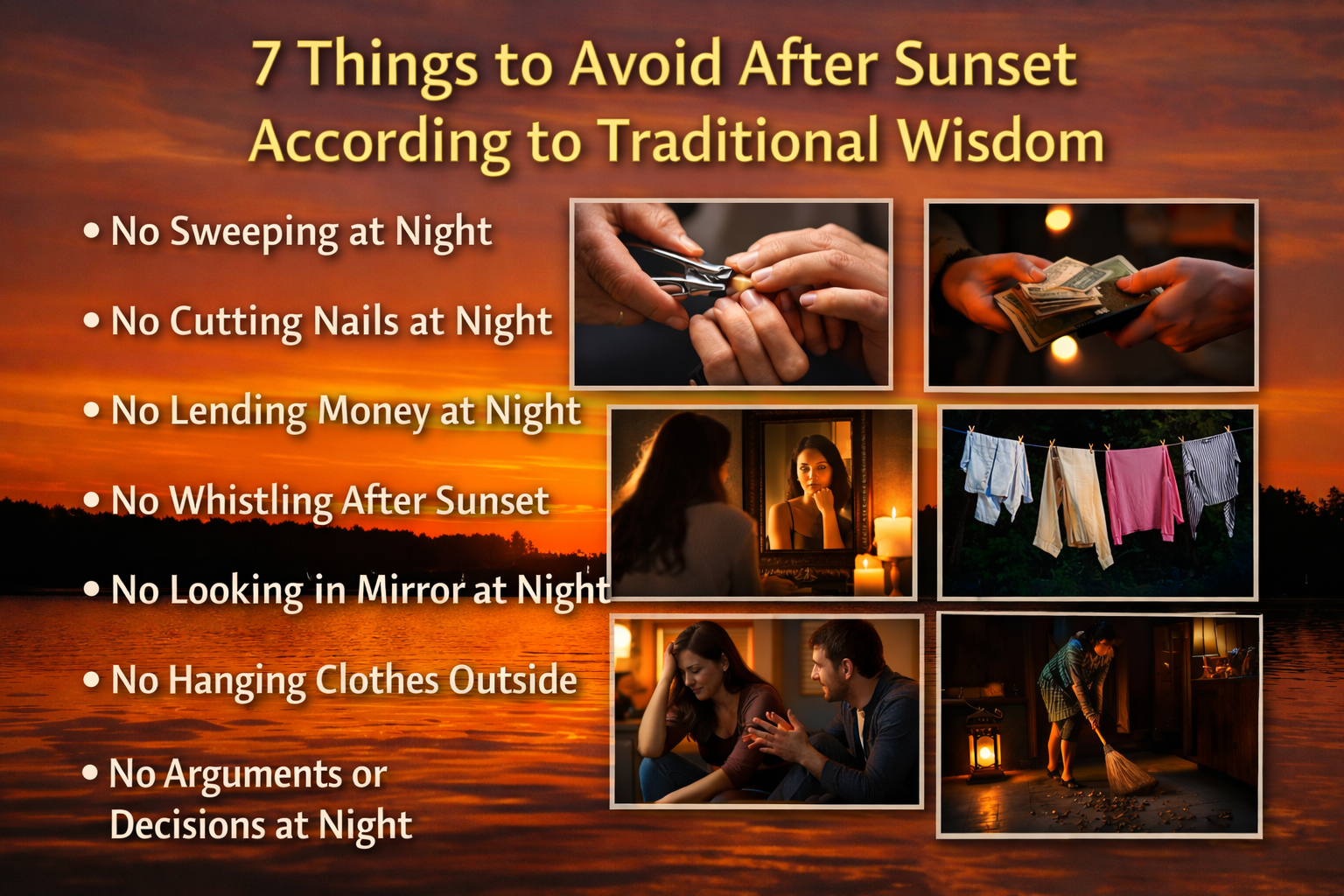
The seven practices discussed — avoiding nighttime sweeping, nail cutting, lending money, whistling, mirror gazing, outdoor drying of clothes, and major decisions — reflect a broader philosophy: respect the rhythm of day and night.
As the sun sets, it may not be about fear or superstition. It may simply be about slowing down, conserving energy, protecting peace, and preparing for renewal.
Related Articles : Upgrade Your Lifestyle with Smart Home Technology