Artificial Intelligence (AI) is no longer a distant concept — it’s actively shaping how we work, learn, and create. Recently, Microsoft Research released a detailed study identifying 40 job roles most exposed to AI technologies, sparking discussion around whether AI will displace certain professions or augment them. This list extends beyond traditional assumptions about automation, touching not just on routine or factory roles, but on knowledge-based and creative professions too.
In this long-form overview, we’ll explore:
- What the Microsoft study measured and why it matters
- Key findings: The 40 jobs most exposed to AI
- Examples of high-risk roles and why they’re vulnerable
- Misconceptions about AI and job loss
- Jobs less likely to be affected
- What this means for the workforce of tomorrow
- How workers and companies can prepare
Let’s unpack the insights and implications of this landmark research.
1. What the Microsoft Study Measured and Why It Matters
Microsoft’s research didn’t simply list jobs “at risk” of being replaced; it quantified how much work within each role overlaps with tasks AI can already perform successfully. Researchers analysed over 200,000 anonymised interactions with Microsoft’s Bing Copilot, assessing jobs based on:
- Coverage – how often tasks associated with a job appear in AI usage
- Completion – how often AI successfully completes those tasks
- Overall AI applicability – a combined measure indicating how amenable a job’s tasks are to AI support or automation
It’s important to note that a high score doesn’t mean a profession will disappear entirely. Rather, it shows how significantly AI could change the nature of work in that role — which tasks could be automated, and which require human judgment, creativity, or interpersonal skill. Microsoft has explicitly stated that no occupation is currently fully performed by AI.
2. The 40 Jobs Most Exposed to AI
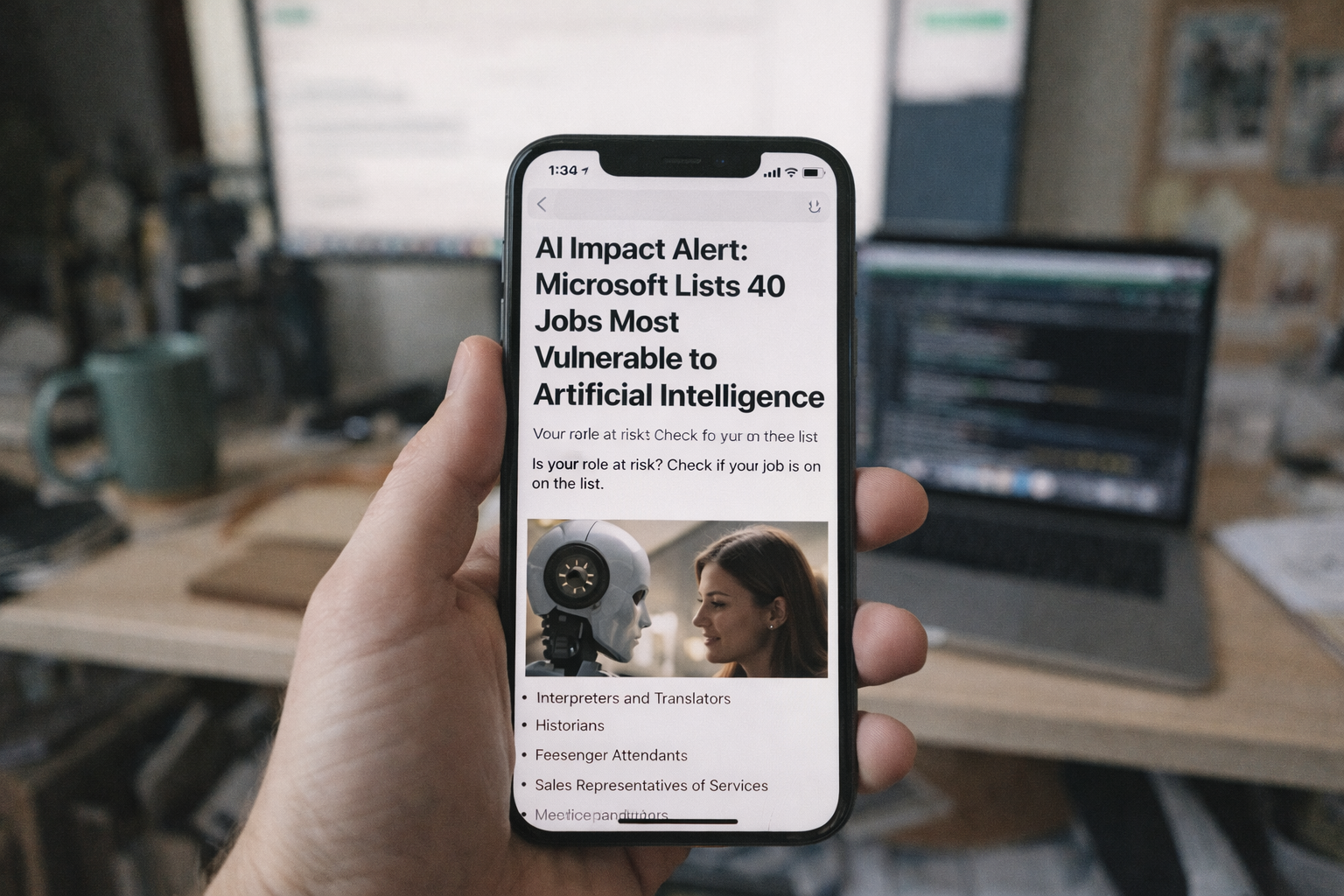
Based on the study’s analysis, the roles most exposed to AI tend to involve language processing, writing, research, summarising information, and communication tasks — areas where generative AI systems already perform impressively. Here are some of the professions frequently highlighted:
- Interpreters and Translators
- Historians
- Passenger Attendants
- Sales Representatives of Services
- Writers and Authors
- Customer Service Representatives
- Telephone Operators
- Ticket Agents and Travel Clerks
- Editors and Proofreaders
- Technical and Copy Writers
- Market Research Analysts
- Management Analysts
- Data Scientists and Computer Systems Analysts
- Financial Advisors and Loan Officers
- Public Relations Specialists
- Postsecondary Teachers in fields like communications and business
These jobs often involve tasks that AI tools already excel at — summarising text, generating draft content, analysing data patterns, responding to routine queries, and even drafting proposals or reports.
3. Why These Jobs Are Vulnerable
Language and Communication Tasks
Roles heavily dependent on text generation, translation, summarising large amounts of information, or interfacing with people through routine dialogue are highly susceptible because modern generative AI (like ChatGPT and Copilot) can already perform these functions with increasing reliability.
For example:
- Translators and interpreters — AI can translate between languages quickly and with high accuracy for many contexts.
- Writers, editors, and proofreaders — AI can draft articles, check grammar, and edit content efficiently.
- Customer service roles — chatbots and automated systems can handle standard customer queries and support tasks.
This doesn’t necessarily mean these roles will vanish overnight. What it does suggest is that a significant portion of the tasks in these jobs could be automated, allowing people to focus on higher-value work like strategy, complex problem-solving, and interpersonal interaction.
Repetitive and Structured Tasks
Even roles like telephone operators, ticket agents, and customer service representatives include predictable, repetitive duties — summarising information, routing calls, answering FAQs — all prime candidates for AI assistance.
4. Common Misconceptions About AI and Job Loss
There’s a widespread fear that AI will simply “take jobs away.” But Microsoft and other industry leaders emphasise that:
- High AI applicability doesn’t translate to full job replacement. Instead, AI often augments productivity.
- Historical parallels show new technology changes job tasks, rather than eliminating roles entirely (for instance, ATMs automated bank teller tasks but didn’t reduce the overall number of bank teller roles in the long term).
- AI is a tool, not a complete substitute for human skill. Human oversight, creativity, and emotional intelligence remain crucial in most professions.
The real impact of AI on the labour market will likely involve job transformation, not just displacement. Workers can use AI to enhance output, focus on higher-order thinking, and streamline workflows.
Also Read : The Impact of AI on Video Production and Brand Personalization
5. Jobs Least Likely to Be Affected by AI
Microsoft’s research also identifies occupations with low exposure to AI — those that require physical presence, manual dexterity, situational awareness, or direct human care. These include:
- Phlebotomists and nursing assistants
- Skilled construction workers, roofers, and concrete finishers
- Bridge and lock tenders
- Water treatment plant and system operators
- Dishwashers and highway maintenance workers
- Surgeons and specialized medical technicians (involving complex human-centric skills)
Jobs that demand empathy, real-world judgment, physical dexterity, or live human interaction tend to be less exposed to generative AI because such tasks are still beyond what current AI can reliably perform.
6. What This Means for the Workforce of Tomorrow
The AI impact study holds several implications for employees, employers, and policymakers:
For Workers
- Skill evolution is critical. Workers in high-exposure roles can benefit from upskilling in areas where human strengths still matter — creativity, leadership, strategy, and complex decision-making.
- AI as augmentation, not replacement. By learning to use AI as a productivity partner, professionals can stay more relevant and competitive.
For Companies
- Integrating AI strategically can boost productivity. Instead of viewing AI as a threat, companies can deploy it to take on routine work and free employees for higher-value tasks.
- Reskilling programs will be essential. Organisations that invest in employee learning and development can better navigate transitions and retain talent.
For Governments and Educators
- Policy and education frameworks must adapt. Preparing the future workforce for AI-augmented roles — with emphasis on human-centric skills — is paramount.
- Safety nets and transition support may be needed for workers in industries facing rapid task transformation.
7. Preparing for an AI-Augmented Future
Here are practical ways individuals and organisations can prepare:
Individuals Can:
- Learn AI tools relevant to their field
- Focus on critical thinking, creativity, and human interaction skills
- Stay updated on industry trends and emerging roles that AI may create
Organisations Can:
- Offer training and reskilling programs for employees
- Integrate AI to enhance roles rather than automate them away
- Encourage roles that leverage human strengths alongside AI
Conclusion: AI Is Changing the Nature of Work — Not Ending It
Microsoft’s list of 40 jobs most exposed to AI reveals the evolving relationship between technology and human labour. While roles involving communication, language, research, and repetitive tasks are more exposed due to how generative AI works today, this does not equate to immediate or total job loss. Rather, it signals areas where human skills must evolve alongside AI to remain relevant and valuable.
By understanding these trends, individuals can adapt, companies can innovate, and policymakers can support a workforce ready for the AI-augmented economy of the future.
If you’d like a breakdown of specific career paths most likely to be safe from AI — or how to future-proof your own job — I can tailor the analysis further!